Showing posts with label Foodie Heroes. Show all posts

Thursday, July 21, 2011

Sharon's Food Heroes: Take Three

It was the enthusiasm that struck me first. There she was, smiling behind her stand in SuperValu, urging passers-by to try her jellies. None of them could resist. When faced with the energetic Melanie Harty, few people can. And once you've admitted defeated and tasted one of her hot pepper jellies, she's got you in her clutches forever.


Since that day I met Melanie in the supermarket, a slice of hot toast spread with cheese and topped with her ginger hot pepper jelly has now become one of my favourite snacks.  The sweetness of the sugar combined with the sweet peppers and the warmth and depth of the ginger and chillies set off by a tangy, salty cheese - I can't think of a better stop-gap between meals. 

While I tasted her jellies that day in the supermarket, I also asked Melanie about her passion for food.  It turns out that she's originally from Tralee but moved to America in the 1980s where she worked in the food industry.  It was here that she first came across hot pepper jellies, which are very popular there, particularly in the spicy, home cooking of Texas and other southern states.

"They love using them in barbeques, in marinades, dips and sauces and with cold meats and cheeses," says Melanie.


She decided to learn how to make her own and once she had perfected her recipes, she brought her hot pepper and jalapeno jellies to farmers' markets, including the Eastern Market on Capitol Hill in Washington DC.  It wasn't long before her jellies - made from entirely natural, simple ingredients - had lots of fans.

"When I returned to Ireland in 1996, I saw that sweet chilli sauce was getting popular," she says.  "That made me think there might be a market for my jellies."

But she didn't start making them immediately.  Instead, she focussed on setting up a restaurant in her home town of Tralee.  The Cookery became an award-winning success, but ten years later, Melanie needed a change.
"I wanted a work/life balance," she explains.  "With the restaurant, it was all work and no balance."

So, once again Melanie returned to her jellies.  Making them at home, she started selling them at markets in Kerry and Cork.  And she found she loved it.
"My passions are food and talking to people," she says.  "This is a great way for me to bring the two together."

She now has six jellies in her range: ginger hot pepper, jalapeno pepper, char-grilled pepper, hot pepper, cranberry and cranberry hot pepper.


And I don't seem to be the only one who likes them either.  Harty's Jellies have won two Shop Awards, Bridgestone Awards and the best emerging food product award at the 2010 Listowel Food Fair.  

I'm looking forward to trying all of the jellies and if you see them for sale, you should try them too.  In fact, if you happen to meet Melanie while she is handing out samples in supermarkets, you won't be able to resist. 
 

Tuesday, June 14, 2011

Meet Prannie Rhatigan, a lady with a mission.

People can be so inspiring, can't they?

This is what I found myself thinking when I spoke to Prannie Rhatigan (great name, right?) a short time ago.

Prannie lives in Sligo and is the author of a wonderful book called 'The Irish Seaweed Kitchen'. With this book, she is hoping to revive the age-old Irish tradition of seaweed harvesting. You may have thought the Japanese were the world's most passionate fans of seaweed but for generations, Irish people used to comb our shorelines for edible seaweeds such as carrageen, sea spaghetti and duileasc.

It was Prannie's father who taught her all she knows about seaweed. He would bring her to the beach to collect seaweed; starting with sleabhac (the traditional Irish name for nori, also known as sloke and laver) after the first frosts of Christmas and continuing throughout the year with alaria, kelp and many other types of seaweed.

She has fond memories of this time. "It was always great fun," she remembers. "Even as kids, there was a tremendous satisfation in careful harvesting, watching the purple-black glistening prize slowly fill the basins. Before the winter evening closed in, we piled back into the car, chugged and bumped up the track to the main road and into the village, where we drew to a halt outside the door of my father's favourite public house; bearers of great treasure. In we trooped and very soon, my father was benignly dispensing little portions in bags to old men in big overcoats who normally huddled over a pint but now became animated at the thought of fresh sleabhac."

However, even when Prannie was a child, the practice of harvesting seaweed was dying away. "By the 1970s, we were among the very few families who harvested from the shore," she says. "I think folk memory still associated it with extreme poverty and the famine."

Her passion for seaweed never abated and she has since become something of an expert in sourcing, identifying, preparing and cooking it. So much of an expert that her family and friends urged her to write this book.

They love my seaweed recipes and kept telling me I should write them down before the knowledge was lost," says Prannie. "So, I finally did."

The result is a book that features 150 recipes covering everything from soup to sushi by way of beetroot and sea lettuce salad and even chocolate and seaweed cake. Most of the recipes are Prannie's own. Others come from her family and friends. And still more come from well-known chefs and cooks such as Darina and Myrtle Allen, Richard Corrigan, Rick Stein and Alice Waters.
But this book is much more than simply a collection of recipes. In it, Prannie captures many of the traditions and folklore associated with seaweed. She tells her readers how the Brehon Laws of the 5th century mention duileasc as a condiment to be served with bread, whey milk and butter (I, for one, would love to try this!). She talks about a survey carried out in Connemara in 1938 which found that the local people ate 32 different types of seaweed.

Prannie also informs her readers about how to source, identify, prepare and store seaweed. She does this because she really wants them to go down to the shoreline and pick some for themselves. "Seaweeds are tasty, healthy and nutritious," she says. "I've always known this but now I really want to pass it on to others. I want everyone to realise just what a living treasure we have on our shores."

She has me convinced. I'm planning to harvest some seaweed the next time we have a new or full moon (the best times to do so, apparently).

Even more excitingly, I'm planning to cook with it. Depending on what type of seaweed I find, I might try seaweed crepes with prawns, laver bread cakes with duileasc or Rick Stein's recipe for black bream steamed over seaweed with a fennel butter sauce.

Yum.
Seriously yum.

If any of you have cooked with seaweed and have any recipes or advice to share, I'd love to hear all about it.

Tuesday, May 3, 2011

Foodie Heroes: Take Two

I've been busy. So busy that I've been neglecting my blog. But not so busy that I haven't been eating, thinking about eating and thinking about the wonderful people who produce the food that I love to eat.

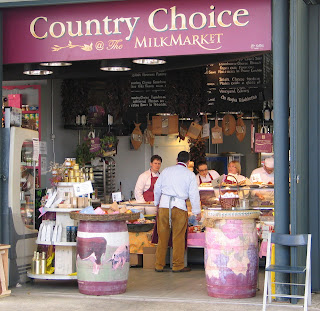
On a recent visit to Limerick, I met Peter Ward, a passionate man who - along with his wife Mary - has run one of the country's most fabulous food shops for the past 30 years. I've been visiting this shop, which also has a small café area, as a pitstop on the way to Dublin for years but have only recently visited their new outlet in Limerick City's Milk Market.
It's just as wonderful as the shop in Nenagh and I thought it was time to tell you all about it and all about Peter.

Peter is fanatical about food and practically evangelical about the quality of the food we produce here in Ireland.
"The excellence of Irish food is our oldest commodity," he says. "Think of our milk products, our black puddings, our seafood, even the oatmeal we've been producing for more than 2,000 years. All of these compare with the very best in the world."

This man should know what he is talking about given that he has devoted his life to food. Growing up in Navan, he lived in a house he describes as "the type of house where the food on the table was more important than the type of car in the drive".
His father loved food. "He was my original food hero," says Peter. "He travelled the country selling cattle and always brought food home from wherever he had been: beef, cheese, fish or black pudding."

After leaving school , Peter got a job with the Dunnes Stores supermarket chain. They sent him to Tipperary, where he met Mary - the woman he was to marry - at a local dance.
They shared a love of good food and decided to set up a speciality food store in Mary's home town of Nenagh. It opened in 1982 and in the years since then, it has become a haven for anyone with an interest in food.

Homemade salad dressings, pestos, the finest coffee beans, olives, farmhouse cheeses, wines; the list of foods you'll find here is long and drool inducing. The one thing they all have in common is that they are all of the highest possible quality.
Or as Peter puts it: "we sell the food we like ourselves, food we'd serve our visitors on a Sunday".

When they first opened their shop, their stock consisted of Mary's jams and the finest produce to be found at local agricultural shows and country markets. "I'd visit every show and market and see who had won what prizes," says Peter. "Then I'd ring them up and ask them if they could supply the shop. That's how we developed our contacts with people."

Their focus was always on organic, natural food. "We had duck eggs, brown soda bread and jam in our window that first day," remembers Peter. "They could be our family crest because they are still the basis of what we do today."

In the 30 years since then, Peter and Mary have added more and more produce to their shelves, including some of the finest artisanal produce from all over Europe. They also make and serve the best of Irish food in their café. Free-range chicken and leek gratin with colcannon, anyone?

"For us, it's all about where the food comes from," explains Peter. "Who makes it and how do they make it? These are the important questions."

This attention to quality explains why Country Choice has become a mecca for foodies in Tipperary and now in Limerick.

It's an attitude that Peter would like to see in all of Ireland's cafés, restaurants and eateries. In fact, he thinks it might be part of the solution to our current economic problems.
"Nobody is going to drop out of the skies into the rural parishes of Ireland," he says. "We need to look to our own and to what we are good at. We are good at tourism and food. Combine the two and work from there."
He believes that every tourist coming to Ireland should look forward to tasting Irish lamb, beef, butter, bread and milk. "And we should deliver on that promise," he continues. "It's treasonable to give our valuable guests cheap, foreign, mass-produced food."

You certainly won't find this at Country Choice in Nenagh. Nor will you find it in Limerick's Milk Market. Instead you will find the very best Irish food and in Peter, you will find a man enthusiastic to show you just how good Irish food can be.

Wednesday, March 23, 2011

Introducing Sharon's Foodie Heroes: Glenilen Farm

On Monday, I travelled along the twisting country lanes of West Cork wondering just how you can get something as smooth and creamy as this:


From such an unassuming creature as this:

Ever since I set up my cupcake stall at Dingle Farmers' Market, I have developed a huge sense of respect for food producers. Until you have tried it for yourself, you have absolutely no idea just how much hard work is involved in producing large volumes of high quality and consistently delicious food. I am usually ready to collapse in an exhausted heap after I've done this for two days a week so I am full of admiration for those who do it on a full-time basis.

Two people who do just that are Alan and Valerie Kingston, whose Glenilen Farm was the destination I was aiming for at the end of those winding country roads. Here they are with some of their fabulously fresh produce:
They make the creamiest of yoghurts, farm-fresh butter, cheesecakes and mousses that burst with fresh flavour, the richest double and clotted cream and much more at their farm near Drimoleague in West Cork.

Arriving at the farm, I was warmly greeted by Valerie and introduced to the lovely Avril Twomey, pictured here to the left. I was ushered into the staff from and over some tea (served with raw milk) and freshly-made scones with jam, we discussed where the company has come from and where it hopes to go.

Glenilen Farm has been in Alan's family for generations but it wasn't until Valerie - who was also born into a West Cork farming family - married him that they started to make dairy produce.

Valerie had studied Food Technology at University College Cork and had set up a community cheese-making enterprise in Burkina Faso in Africa after she left college. Finding herself newly married in Drimoleague, she decided to use the skills she had learned in college and refined in Africa to make cheese from the raw milk produced by the farm's 55 Fresian cows.

She started with fromage frais and once she had mastered that, she moved on to making cheesecakes and yoghurts in her kitchen. Pleased with the results of her experiments, her next step was to set up a stall at Bantry's Farmers' Market. From there, it wasn't long before she had regular customers who loved her produce just as much as she did.

That was back in 1997 and what started as a small farmhouse kitchen enterprise has grown to become a business that now employs more than 20 people. It's a business with an ever-expanding product range too, thanks to Valerie who continues to experiment with new flavour combinations and recipes in her kitchen. And instead of farmers' markets, these products are now sold in shops all over Ireland and outlets including Tesco's in the UK.

Despite all of these changes, many aspects to life on Glenilen Farm remain the same. As Avril shows me around, I can't help but notice that this is still very much a traditional family-run farm. Chickens scratch and preen in the chicken coop. People trundle by with wheelbarrows. The family cat sidles up to visitors, always on the lookout for some fresh cream. And then there is the produce itself.

Alan and Valerie may have upped production but they have also stuck to their principles. They want their food to taste good and to retain its farmhouse-fresh quality. With this in mind, they have refused to introduce any additives or preservatives and they remain committed to the quality of their food.

This means that what they do still involves a lot of hard and hands-on work. Avril tells me about the blisters everyone had on their fingers back in the days when their yoghurt tops were still fitted by hand and describes the groans the staff still make any time there is a big order of butter, which still has a string that is tied by hand.
It seems these are sacrifices the staff are willing to make. What I spy of the production unit is a place where people seem to take palpable pride in their work.
"Everybody who works here is focussed on making our food taste good," says Avril. "We want it to taste fresh. That's why even when we use machines, we are still close to the food. We don't want to be distanced from it. We want to be close enough to see, smell and even taste it."
You can taste this passion and pride in their produce. Glenilen yoghurt is yoghurt as it was meant to taste; smooth and creamy and full of fresh and natural goodness. When you bite into a slice of Glenilen summer berries cheesecake, you can't help but relish the buttery biscuit base, the fresh whole berries and the full-fat creaminess of the cheese. Yum!

I came home from my day at Glenilen Farm laden down with goodies, some of which I've pictured here:
I've already eaten some of the yoghurt for breakfast. I spread some of the butter on my toast this morning. I've shared some of the cheesecake with friends. I've enjoyed every mouthful and am looking forward to many more.

Alan and Valerie and their team of 20 or so staff at Glenilen Farm represent so much of what is good about Irish food. Using traditional farming methods and age-old techniques of cheese, butter and cream making, they produce food that is fresh, natural and a joy to eat.

It was totally worth making the long and winding journey to Glenilen Farm.